Amendments to Provincial Electoral Legislation Now in Force
April 29, 2026
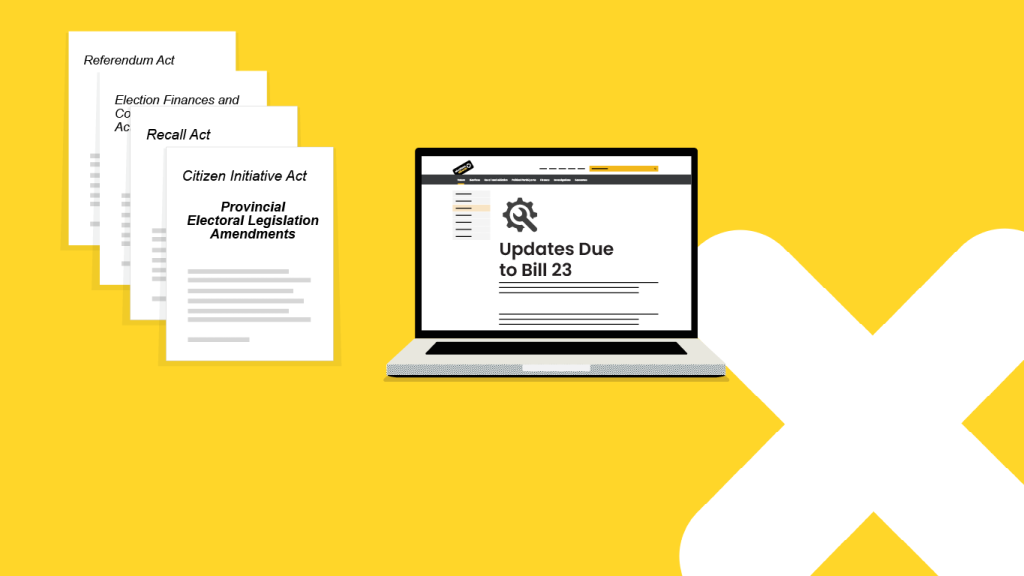
EDMONTON – On April 16, 2026, amendments to electoral legislation introduced in Bill 23: Justice Statutes Amendment Act, 2026 for the Election Finances and Contributions Disclosure Act (EFCDA) and the Recall Act came into force upon Royal Assent, while amendments to the Citizen Initiative Act come into force on May 1, 2026. Amendments to the Citizen Initiative Regulation and Referendum (General) Regulation came into force by Orders in Council on April 23, 2026.
These legislative amendments primarily address the prohibition of deepfakes under the EFCDA, application of the EFCDA to referendums, and allow for the appointment of scrutineers to observe the referendum and petition verification process under both the Citizen Initiative Act and Recall Act. Further, the Referendum (General) Regulation amendments set out time limits for the unofficial count and require question(s) arising from a successful citizen initiative petition to begin being counted first.
“Elections Alberta’s mandate is to support fair and impartial electoral events and ensure political participants’ accountability through administering, monitoring, and enforcement of electoral legislation,” said Gordon McClure, Chief Electoral Officer. “My Office has revised our operational processes to include the changes to the referendum, citizen initiative, and recall processes, and will be developing processes to support the deepfake provisions in the EFCDA, including supporting awareness of and compliance with the new requirements.”
Fact sheets have been developed and posted on Elections Alberta’s website, under each of the affected Acts. Other Elections Alberta website content will be updated to reflect these changes.
Key Impacts to Citizen Initiative Act and Citizen Initiative Regulation
- Amendments to the Citizen Initiative Act and Regulation provide for the appointment of scrutineers who are lawyers and active members of The Law Society by both the petition proponent and Minister of Justice to observe the signature verification process, and sets out their duties and responsibilities.
- The initiative petition period and signing period have been changed to exclude the 12-month period preceding a fixed date provincial general election, from the date a writ is issued for a general election on any other date, or in the 12-month period immediately following a provincial general election. Any notice of intent, application for issuance, initiative petition signing period in progress, or determination period in progress at any of these times is immediately terminated, and the petition is deemed unsuccessful.
- Requirements to hold a referendum for a successful policy proposal petition before the next fixed date general election or following the next fixed date election (if it is less than one year after the date on which the report recommending a referendum is tabled) were repealed.
Provisional clauses apply these amendments to current citizen initiative petitions in progress. This includes both the “A Referendum Relating to Alberta Independence” petition and the “No New Coal Mining in the Eastern Slopes of the Rocky Mountains” petition.
Key Impacts to Recall Act
- Amendments to the Recall Act allow for the appointment of scrutineers who are lawyers and active members of The Law Society by both the petition applicant and the Member named to observe the signature verification process, and sets out their duties and responsibilities.
Key Impacts to Election Finances and Contributions Disclosure Act
- Amendments to the EFCDA add provisions prohibiting deepfakes.
- Deepfakes include any depiction in a video, audio, photographic, digital, or other medium of a leader of a political party, leadership contestant, Minister, member of the Legislative Assembly, candidate, nomination contestant, Chief Electoral Officer, Election Commissioner, election officer as defined in the Election Act, person who is or was employed or engaged by the Office of the Chief Electoral Officer to carry out the duties of the Chief Electoral Officer or person who is or was employed or engaged by the Office of the Election Commissioner to carry out the duties of the Election Commissioner. There is no exception for satire.
- Prohibits a person or entity from the creation, distribution, and publishing of deepfakes that are likely or intended to mislead electors.
- The amendments grant the Chief Electoral Officer authority to have the deepfake removed or discontinued and provides the Election Commissioner the power to compel a person or entity to stop creating, distributing, or publishing a deepfake and destroy it.
- It establishes administrative penalties for both creating, distributing, and publishing deepfakes and failing to comply with the Election Commissioner’s direction to stop creating, distributing, or publishing a deepfake and destroy it of up to:
- $10,000 per day on which the offence occurs or continues, for a person, or
- $100,000 per day on which the offence occurs or continues, for an entity.
- It further sets fines for failing to comply with the Election Commissioner’s direction of up to:
- $10,000 for a person, or
- $100,000 for an entity.
- Under revisions to the Referendum (General) Regulation, removes applicability of the EFCDA to a registered party, constituency association, or MLA for a referendum.
Key Impacts to the Referendum (General) Regulation
- Amendments to the Referendum (General) Regulation set out a definition for an official party to mean a political party that has more than 4 MLAs on the earlier of the date a referendum is ordered or an election writ is issued, and received at least 5% of the popular vote in the most recent provincial general election.
- As noted above, removes applicability of the EFCDA to a registered party, constituency association, or MLA for a referendum.
- Allows official parties and proponent(s) of a referendum resulting from a successful citizen initiative petition to appoint scrutineers to observe the referendum voting processes and unofficial ballot count. Appointments must be made in writing to the Chief Electoral Officer no later than 8 weeks before election day.
- Allows the Chief Electoral Officer to appoint additional third party advertiser scrutineers, considering their position on a referendum question, if the official parties or proponent(s) do not appoint scrutineers or the Chief Electoral Officer determines additional scrutineers should be appointed.
- Requires any question that is the result of a successful citizen initiative petition to begin being counted first at each voting location and station, and unofficial results to be published as they are received from returning officers.
- Sets new time limits for the unofficial count for a referendum, requiring it to be completed no later than:
- 12 hours after close of voting if there are 1 or 2 questions,
- 24 hours after close of voting if there are 3 or 4 questions,
- 36 hours after close of voting if there are 5 or 6 questions, or
- 48 hours after close of voting if there are 7 or more questions.
Elections Alberta is an independent, non-partisan office of the Legislative Assembly of Alberta responsible for administering provincial elections, by-elections, and referendums.
For media inquiries, please contact:
Michelle Gurney
Media Relations
Phone: 403.431.0759
Email: [email protected]
Posted in: Press Releases